Summary
As a university-supported and faculty-driven transdisciplinary research center at George Mason University, CAHMP- The Center for Advancing Human-Machine Partnership, facilitates fundamental and translational research, teaching, and innovation in understanding and leveraging human-machine partnership to solve current and emerging societal problems.
CAHMP adopts the Science of Team Science to coordinate teams of scientists from across disciplines, campuses and institutions to form dynamic research efforts that are larger in scale, broader in scope, and more inclusive of marginalized disciplines and researchers
OnAir Post: CAHMP
News
Call for Applications: CAHMP Summer 2025 GRA Fellowship
We are inviting applications for a limited number of summer GRAs from Mason doctoral students who do not already have Mason summer funding. If accepted, each awardee will receive a stipend of $9,000 this summer. Applying students should provide a short summary of what project they will be working on over the summer. While we will consider all projects concerning human-machine partnerships, special consideration will be given to transdisciplinary projects centering around CAHMP thematic thrusts:
- Fairness, Accountability, Transparency, Inclusion, and Equity in AI
- AI Policy and Governance
- Human-Computer Interaction (human-machine teaming)
- Assistive Technology
- Learning Technology
- Community Informatics
- Generative AI and applications
(including AR/VR, computer vision, wearable tech, robotics, cyber, data science, digital humanities, etc.)
Recipients of this summer funding may be
About
Overview
Vision
Humans and machines must be able to communicate seamlessly while dynamically learning from each other in a personalized context, and they must do so within a collaborative framework that engenders trust and ethical conduct.
Mission
There is great social anxiety regarding human-machine partnerships, prompting fundamental questions on our role, individually and collectively. The mission of CAHMP is to transform social anxiety into social resonance by pursuing convergent research on how to restructure and optimize reciprocal relationships between humans and assistive computing systems.
Research
CAHMP is a catalyst of convergent, interdisciplinary, and fundamental research on human-machine partnership dynamics, focusing on: (1) Intuitive communication (2) Adaptive interactivity (3) Ethical partnership (4) Cross-cutting societal impacts
Outcomes
Fundamentally transform human-machine partnerships via convergent research
Build research capacity by student training and development
Contribute open-source software platforms, tools, and data
Better our community and the broader society via discoveries shaping the future of work, education, and cross-cutting social, economic, political, and health infrastructure and policy.
Source: Website
Contact
Locations
George Mason University
4400 University Drive
Fairfax, Virginia 22030
Phone: 703-993-4813
Web Links
Global City Teams Challenge
CAHMP Co-directors, Brenda Bannan (Principal Investigator) & Dave Lattanzi (Co-Principal Investigator) (2022) lead Global City Teams Challenge Strategic Planning Workshop Working Group Series, sponsored by National Institute for Standards and Technology (NIST). The CAHMP team submitted the proposal in March, 2022 and was awarded $89,390 over one year.
In 2022, the National Institute of Standards and Technology (NIST) awarded funding to George Mason University (GMU) to conduct a two-part workshop series to develop an integrated and supportive community-centric strategy to inform, strengthen and expand the Global Community Technology Consortium (formerly the Global City Teams Challenge) (GCTC) program, in an effort to facilitate and enhance smart and connected communities technology research, development and application.
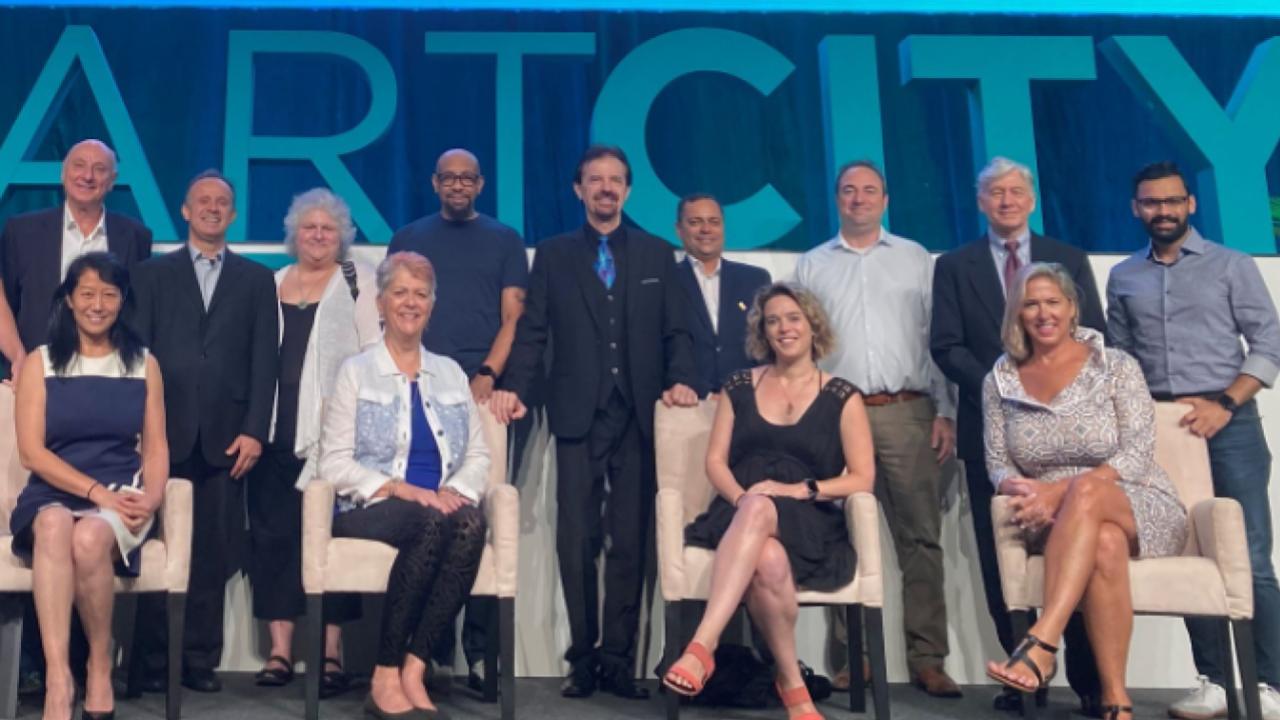
In early August of 2022, the GCTC leadership convened in Arlington, Virginia, at Mason Square on GMU’s Arlington campus as the first workshop meeting in a two-part series. This first workshop, sponsored by the Center for Advancing Human-Machine Partnerships (CAHMP) at GMU and organized by Dr. Brenda Bannan, was designed to establish a strategic research vision for the GCTC. The workshop provided the leadership of the twelve SuperClusters, also known as Technology Sectors, an opportunity to better understand how the GCTC interacts with internal and external partners to achieve technology deployment and implementation for the purpose of informing the strategic vision. This workshop was followed by a mid-September workshop sponsored by the City of Coral Gables, Florida, and held in their Public Safety Headquarters Smart Building. Augmenting the findings of the first workshop, the second workshop held was designed to delineate the specific priorities and activities of the strategic plan. The leadership of this organization, including Dr. Bannan, attended the SmartCity Expo USA in Miami, Florida as part of the event.
Synthesized results from this workshop series: 1) inform and guide the strategic directions of the NIST GCTC organization to benefit communities and the public related to advanced cyber-physical technologies; and 2) yield insights into the complex and interdependent challenges of disseminating and implementing technology in the smart and connected communities vision.
Current CAHMP Projects
AI Informed Education Policy
Interactive Augmented Reality
Minerva AI Strategies
Smart City Initiatives
AI and Technology Fellowship
CAHMP HCI Group
Human-machine Partnership Seed Fund
Entrepreneurial Training
Research
Expertise
Source: Website
- the Volgenau School of Engineering (VSE)
- the College of Education and Human Development (CEHD)
- the College of Humanities and Social Sciences (CHSS)
- the College of Sciences (COS)
- the College of Visual and Performing Arts (CVPA)
- the Schar School of Policy and Government
VSE members cover the departments of Computer Science (Shehu, Barbar, Yu), Information Sciences and Technology (Purohit, Zhang), Statistics (Qiao), and Civil, Environmental, and Infrastructure Engineering (Lattanzi).
These members bring their expertise in (explainable) AI, adaptive optimization, active machine learning, data mining, big data informatics and scalable machine learning, cybersecurity, disaster and health informatics, human-AI collaborations for smart cities, interpretable and generative deep learning, event forecasting and spatio-temporal modeling, statistical inference, high-dimensional data analysis and visualization, robotics, structural engineering, computational design, virtual reality, spatial computing, human-centered computing, cognitive science, and more.
- Partnerships for Social Good
- Smart, Human-Centered Engineering Design
- Virtual Reality Simulations for Workforce Training
- Intelligent Tutoring Systems for Personalized Learning
- Trust, Ethics, Partnership Structures
- Socio-Economic Impacts
- Health Monitoring, Exergaming, Passive Preclinical Detection
- Impact of Human Behavior on Cyber Security
- Resilience of Cyber systems to Human Behavior
- Robust and Adaptive Cyber-Human System Collapse